

Creaticty , Activity ve Service
SEPTEMBER / Advised % completed 5%
Initial CAS briefings and workshop
Visit Volunteer Market
1st recorded experience in MB and approved proposal by the end of the 4th week of the
school year, meaning you should have been active using Managebac by this time.
First meeting with your Advisor: You should have a plan for at least one experience and
understand how it will help you achieve some CAS learning outcomes.
OCTOBER / Advised % completed 10%
Oct Brainstorm project and experiences and start planning your involvement in CAS over the
duration of your Diploma Programme.
Add new experiences in your portfolio and get approval
NOVEMBER / Advised completed 10%
Plan CAS project and work on the proposal
Progress meeting with your Advisor
DECEMBER / Advised completed 20 %
CAS Project recorded in MB and proposal approved 20%
By this time you should have completed several experiences and have the next upcoming
experience proposals approved.
You should submit your first self assessment report to the CAS coordinator
CAS planning completed
By this time you should have most of your experience descriptions and supervisor details
uploaded
First interview with coordinator
JANUARY / Advised completed 30 %
CAS planning completed
(By this time you should have most of your experience descriptions and supervisor details
uploaded)
Progress meeting with you Advisor
March
Progress meeting with your Advisor
April / Advised completed 40 %
You should have demonstrated and documented substantial engagement in a number of
CAS experiences
May / Advised completed 50 %
Second interview with coordinator: at this stage you should be able to display your
progress and discuss both your evidence and reflection so far. Each learning outcome
needs to be covered (completed) at least 1 once at this stage.
June
CAS DAY proposal approved
Progress meeting with your Advisor
Discuss CAS day proposal, involvement in CAS over the summer holiday
July / Advised completed 60 %
CAS DAY (in or out school planned activities) 60%
At this stage I advise you to have each learning outcome covered (completed) at least
twice.
SEPTEMBER / Advised completed 70 %
From this point on I advise having no more than 3 active CAS experiences ongoing 70%
Progress meeting with your Advisor
NOVEMBER
Progress meeting with your Advisor
DECEMBER / Advised completed 80 %
From this point on I advise having no more than 2 active experiences ongoing
Third interview with coordinator: at this stage you should have evidence for the majority
of the CAS outcomes and most of your supervisor reviews completed.
JANUARY
Progress meeting with your Advisor
MARCH / Advised completed 95 %
CAS project finished (final deadline before the presentations take place) 95%
CAS project presentations
You will be asked to fill out a feedback form detailing what you believe are the strengths
and areas for growth of the ISB CAS programme
Evaluation meeting with your Advisor
April Advised completed 100 %
All CAS portfolios completed and ready for submission to the IBO 100
MAY
DP Exams
IMPORTANT
It is imperative that your engagement in CAS demonstrates continuity throughout the 2
years of the DP. There cannot be any interruptions in your CAS timeline, even over the
summer holiday between DP 1 and DP 2.
Reflection Tools
In reflection it is important that it challenges and guides you in developing critical thinking about your
experiences. Reflection is what enables you to think critically about you experiences and to learn
independently.

Reflection throughout the different CAS stages
As described before, reflection should be an ongoing process, taking place over time. It should
influence and be influenced by your decisions and actions at each of the CAS stages.
Reflection before: Investigation and Preparation
In the first two stages you will consider how you might use prior learning in new contexts. It is the
moment of inquiry, and provides you with opportunities to develop decision-making skills. All three
elements of the DP (EE, TOK, CAS) should be grounded in three coherent aims, including support and
be supported by the academic disciplines. You may discover information, methods of analysis, great
ideas and proposals for significant CAS experiences in other DP subjects. TOK may provide interesting
questions to ask yourself before deciding to take any action.
Reflection during the experience: Action
In this reflection you would focus on your actions, deal and discuss your problem-solving skills by
considering alternatives and courses of action in order to understand what you are doing well and
what needs to be improved.
Reflection after the experience: Demonstration and communication
Afterwards you will do a self-evaluation, try to take a step back from your work and discuss your
ideas, questions, share your changing perspectives and draw conclusions and think about the learning
outcomes that you have achieved. You will demonstrate your achievement and progress of the
learning outcomes by reflecting on your CAS experiences included in your portfolio.
The different parts of the reflection process
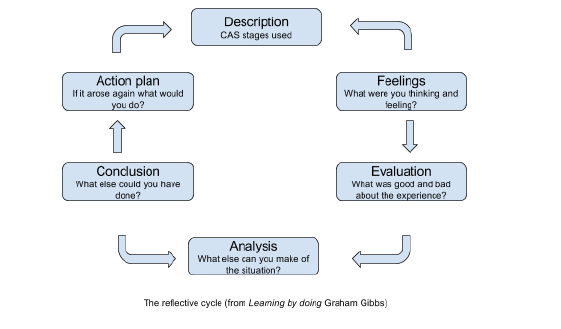
The reflective cycle below captures the main points of the different parts of the reflection process.
There are many ways to represent and carry out a reflection process. What matters is that you find
your own style and follow the process at your own pace.
Reflection can be carried out in countless forms. You should be able to identify ways of expression
that you find enjoyable, and which are a good fit with the nature of the experience and you personal
learning style. You can consider any of the following forms:
• Online: websites, blogs and other social media, apps, power point presentations
• On paper: drawing, creating a poster, letter, chart or scrapbook
• Dramatic or visual: a dramatic performance, video, audio, a verbal presentation, a song,
poem, comic strip, photography etc.
Here are some ideas to work through, with questions to guide you. Remember this is not a linear
process; these are moments that make up a whole reflection process. You can go through the
different moments in different stages.
• Describing the situation
What happened? What is happening?
• Analyzing them and unwrapping the experience. Each experience may have emphasis on
different parts of your personality and contribute in different ways.
How have I felt, or how do I feel now? How do I think others have felt? What were the
activities carried out? What abilities and attitudes were put into action be others and me?
Why have I acted this way? What did I expect to accomplish by this experience? What have I
worked with?
• Evaluating situations and making sense of what happened
What have been the outcomes of the experience? For me and for everyone
Involved? For the environment. Have I achieved my objectives? What difficulties did I
encounter? How and what did I do to overcome them? What else could I have done
differently?
• Drawing conclusions and learning achieved
What did I learn from this experience? What of the IB learner profile attributes did I
develop? Was I able to build or develop any good? For me, for others, for the community?
• Changing perspectives, generating ideas, asking questions
How did my decisions impact on others’ lives? What are the consequences of my decisions
and actions for others, the environment and me? What did I discover about others, the
community and myself? Have I changed my perspectives? In what way?
• Planning further actions and looking ahead
How can I apply what I have learnt in other life situations?
CAS & TOK
CAS and TOK have some common ground, which can help you to write compelling reflections. As you
get to learn more about both, you can use this to your advantage. TOK explores a number of ‘Ways of
Knowing’ that can be useful in analyzing your CAS experiences in order to draw out learning but also
the other areas of TOK prove to be useful in deepening your reflection. See appendix CAS and Theory
of knowledge for more information.
• Language: Which types of language were used and were relevant to this experience, why?
• Sense perception: What did you see, hear, smell and feel (touch) during the experience?
• Emotion: How did the experience make you feel before, during and afterwards?
• Reason: what logical conclusions can be drawn from your experience?
• Imagination: What did you anticipate your experience would be like before it happened?
• Faith: Does your faith give you a perspective on this experience? If so what is it? Intuition:
Does your logical analysis of the experience differ from your “gut feeling”?
• Memory: Which previous experiences of yours were relevant to this one and why? v
CAS & EE
CAS and the EE share their relationship in finding an inspiring topic for your Extended Essay. Your CAS
experiences can serve as inspiration for choosing a particular topic for your Extended Essay. You will
find further information on this in Appendix CAS and the Extended Essay
CAS & ATL
The approaches to learning (ATL) are part of a broad educational approach to prepare you for life
after school. You will definitely work on and develop your ATL skills throughout the CAS programme.
If you want to now specifically which attributes of the five categories of ATL skills you will develop
through CAS, you can read Chapter 9 of the CAS textbook. A reflection on your developing ATL skills
could definitely become part of your reflections.

Bono’s thinking hats
Each hat let you think about your activity in a different way, in turns you put on the 6 different hats
and note down what you think.
White hat: Pure facts. Write down the facts about the activity did you fulfill your
goal considering the specification you have set for yourself?
Black hat: Negative thoughts. What didn’t you like or what wasn’t successful?
Yellow hat: Positive thoughts. What worked well? What did you enjoy most?
Red hat: Emotions. How did this experience make you feel?
Green hat: Creative thoughts. How would you improve or what would you do
differently?
Blue hat: Thinking about thinking. Can you summarize this activity? Was this the
right thing to do for this issue?
 gozdetorunacademy