

- Final accounts
- Financial statements that inform stakeholders about the financial profile and performance of a business
- Businesses need to keep detailed records of purchases, sales, inventory, and other financial transactions
- Important terminology
- Current assets
- Liquid assets are assets that are easily turned into cash
- Current assets
- Aside from cash
- Debtors – money owed to the company
- Aside from cash
- Stocks – unsold inventory
- Money owed by the business, must be paid by 12 months
- Overdrafts – short term loan to cover cash problems
- Creditors – money owed to suppliers for goods bought on credit
- Tax
- Working capital
- Money needed by the business for its daily operations (running costs)
- Also known as net current assets
- WC = Current assets – Current liabilities
- Working capital is needed as buffer for expected shutdown in cash flow
- Principles and ethics of accounting practices
- These are general rules and concepts that govern the field of accounting
- Failure to uphold accounting ethics in businesses can result in legal challenges
- Window dressing
- Also called creative accounting; legal way of manipulating financial statements.
- Manipulations include:
- Different stock valuation (FIFO/LIFO Pricing)
- Unrealistic valuation of intangible assets
- Classifying current liabilities as long-term liabilities
- Sale of fixed assets to improve working capital
- Debtors may be included to boost profit
- Profit and loss account/income statement
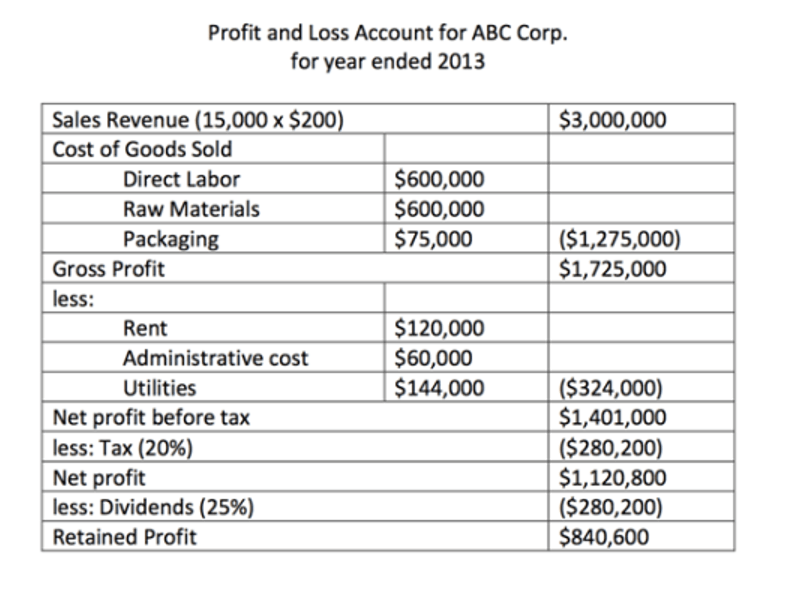
- Shows the trading position of the business over a period of time, determining the income, profit or loss
- Parts of an income statement
- Heading: Profit and loss for (company name) for year ended (date)Trading account – shows the difference between sales and direct costs
- Profit and loss account
- Shows operating or net profit after deducting operating expenses and interestsDepreciation is included as expense
- Profit and loss account
- Trading account
- Shows Gross Profit = Sales revenue – Cost of sales
- Trading account
- Revenue = amount earned from sales
- Cost of Sales/Goods Sold = Value of inventory + Purchases – Closing Stock OR Variable cost x Quantity soldRemember: not all sales are from cash; sales revenue is not the same as cash received by the business.
- Deduct overheads from gross profit to get operating profit (or net profit before tax and interest)
- Appropriation account
- Interest subtractedNet profit before tax
- Taxes – Compulsory income tax (levy on profits)Net profit after tax
- Subtract Dividends – share of profits distributed to shareholders
- Retained Profit – how much of the profit is left in the business for future development
- Balance sheet
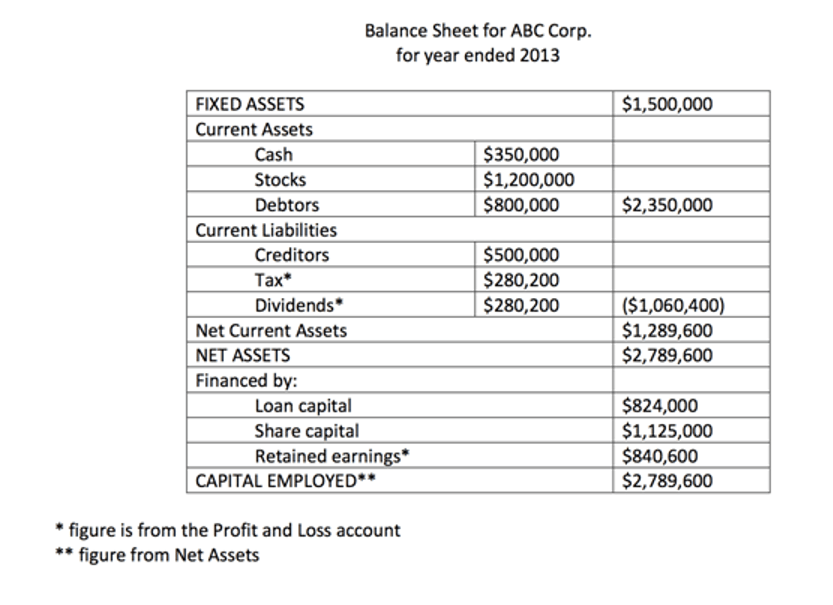
- Shows the overall value, thus financial position of a company at a specific dateIncludes value of assets, liabilities, and capital employed
- Shows where a firm’s money came from and how it was spentBalance sheets are useful if there’s a prior balance sheet to compare with
- Net assets = Liabilities + Owner/Shareholder’s equity
- Balance sheets comprise
- Title on top: Balance sheet for (Company) as at (Date)Assets
- Fixed
- Items purchased for business use (not for sale in the near future)Tangible – physicalIntangible – non-physical assets (e.g. brand name, goodwill, patents, etc.)Investments – medium to long term investments or government bonds
- Fixed
- Title on top: Balance sheet for (Company) as at (Date)Assets
- Current liabilities
- Net assets = Working capital + Fixed assets
- Share capital – money raised through the sale of shares
- Retained profits – money left for business use (usually based on the current income statement)Reserves – proceeds from the retained earnings from previous years; may also include capital gains on fixed assetsLoan capital
- Therefore, the source of funds matches the use of funds
- Types of intangible assets:
- Trademarks
- Intangible asset legally preventing others from using a business’ logo, name, or other branding
- Protects the author’s ownership of his work
- Trademarks
- Legal right to publish one’s own work
- Grants a company the sole right to manufacture and sell an invention for a period of time, usually 20 years
- Only inventions that are new, not obvious, and not a combination of previous inventions, can be patented
- Grants a company the sole right to manufacture and sell a new item, but for a shorter period of time, usually 7 years
- Different from a patent – a utility model can simply be a new way of using an existing iteme.g. using a bucket as Chickenjoy container
- Set of intangible assets, impressions, and reputations associated with a name, brand, or logo, that differentiates it from competitors
- Goodwill
- The established reputation of a business is regarded as a quantifiable asset
- Represented by the excess of the price paid at a takeover for a company over its fair market value
- Limitations of income statement and balance sheet
- Takes time to prepare (could have lost on the way)Needs comparison with historical records
- The data is purely quantitative
- Auditing – the process of examining and validating financial accounts by an external entity to protect all stakeholders
- Depreciation (HL only)
- Fall in the value of fixed assets over time
- Spreads the historic cost of an item over its useful lifetime
- Opposite of depreciation is appreciation
- Depreciation helps reflect the value of the business more accurately
- Helps the business plan for asset replacement in the future
- Depreciation is recorded as an expense, yet no money is actually spent (should show up in expenses in the income statement, but will not appear in cash flow forecast)
- Calculating depreciation
- Straight-line method
- Constant amount of depreciation is subtracted from the value of the asset each year
- Straight-line method
- Simple but unrealistic since assets usually depreciate faster at the start of the lifespanRequires estimates on both life expectancy and residual value
- Does not consider effect of obsolescenceRepairs and maintenance cost of assets usually increases with age, thus reducing the profitability of the assetAnnual depreciation = (Purchase cost – Residual value) / Lifespan
- Reducing balance method
- Calculates depreciation by subtracting a fixed percentage from the previous year’s net book value
- More accurate than the straight-line method but more complex
- By calculating a precise rate of depreciation, it suggests a level of accuracy for the process of depreciation, which is unjustifiedResidual value and life expectancy are always estimates
- Net book value = Historical cost – Cumulative depreciation
 gozdetorunacademy