

What is an Extended Essay (EE)?
General requirements
The extended essay is an in-depth study of a focused topic chosen. It gives you the opportunity to;
- engage in independent research with intellectual initiative, creativity, and rigor,
- develop research, thinking, self-management, and communication skills,
- reflect on and record what you have learned throughout the research and writing process (The whole reflection process will be separately assessed based on your words on the Reflection on planning and progress form (RPPF).
Key features of the EE
- The extended essay is compulsory for all students taking the Diploma Programme.
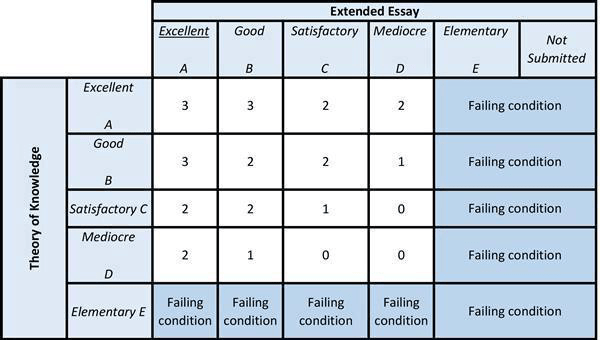
- You must achieve a grade of D or higher (A, B, C) to pass the Diploma Programme.
- The EE is externally assessed and together with marks for TOK, contributes between 0-3 bonus points to the total score for the DP.
It is a piece of independent research on a topic you choose in consultation with your supervisor.
It is presented as a formal piece of academic writing, well-argued and coherent, of no more than 4,000 words.
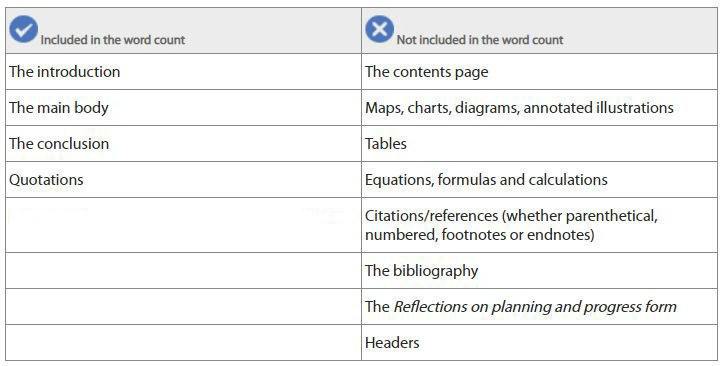
EE Word Count Table (Included & Not Included in the Word Count)
It is accompanied by a reflection form (RPPF) of no more than 500 words, uploaded with the EE.
The EE is the result of approximately 40 hours of work.
The whole process includes three mandatory reflection sessions (first reflection session, interim reflection and final reflection/viva voce) and some check-in sessions with the supervisor with you writing your reflections on the RPPF after each session.
ManageBac and Google Classroom are the online systems where you store and upload your EE as well as your RPPF (check this with your supervisor).
Subject & Topic
The topic is chosen from the list of approved Diploma Programme subjects.
You should choose a topic you find both interesting and challenging. Make it a joyful ride: choose a topic you are passionate about!
The topic must be narrow enough for an in-depth study.
Extended Essays in group 1 are only intended for candidates whose mother tongue is the language A chosen for the EE. Extended Essays in group 2 are only intended for second-language learners.
If you choose Turkish as your subject (group 1), the EE must be written in Turkish. Other EEs must be written in English.
Assessment objectives
For a good quality extended essay, the students are expected to:
- plan and pursue a research project with intellectual initiative and insight,
- demonstrate knowledge and understanding of the topic chosen and formulated research question,
- gather and interpret material from sources appropriate to the research question,
- structure a reasoned argument in response to the research question based on the material gathered,
- present their extended essay in a format appropriate to the subject, acknowledging sources in one of the established academic ways (properly formatted and neatly set out),
- use the specific terminology and concepts appropriate to the subject with skill and understanding,
- apply analytical and evaluative skills appropriate to the subject, with an understanding of the implications and the context of their research.
How is it assessed?
- Externally assessed (All extended essays are externally assessed by examiners appointed by the IB)
- Max. 34 marks, 5 Assessment Criteria
- Criterion E (6 marks) based solely on reflections
- Passing grade: D
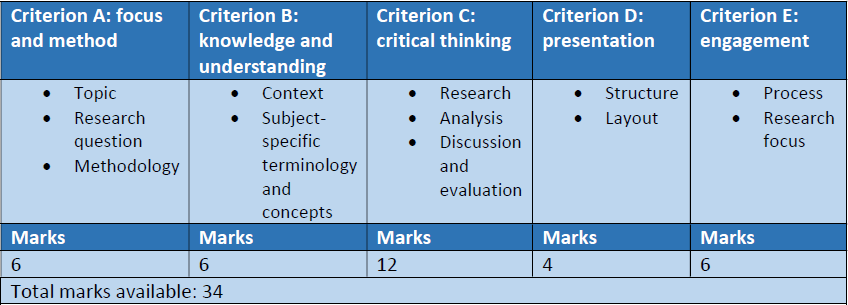
Assessment criteria are generic/ the same for all subjects but they are used together with the relevant subject-specific interpretations. These interpretations articulate how the generic assessment criteria are understood and applied to each subject (ask your supervisor to give you a hand-out for your subject).
Unpacking the criteria
The following is intended to help you understand each criterion in terms of what should be included in the extended essay to achieve the highest level.
Each criterion is organized at three levels of information. Firstly, the markband, which relates to the mark range available; secondly, the strand, which relates to what is being assessed; and, thirdly, the indicators, which are the demonstration of the strands within a markband.
For example:
Mark band 1–2
(Strand) The topic is communicated unclearly and incompletely. (Indicators of the strand)
- Identification and explanation of the topic is limited; the purpose and focus of the research is unclear, or does not lend itself to a systematic investigation in the subject for which it is registered.
(Strand) The research question is stated but not clearly expressed or too broad.
(Indicators of the strand) - The research question is too broad in scope to be treated effectively within the word limit and requirements of the task, or does not lend itself to a systematic investigation in the subject for which it is registered.
- The intent of the research question is understood but has not been clearly expressed and/or the discussion of the essay is not focused on the research question.
(Strand) The methodology of the research is limited. (Indicators of the strand)
(Indicators of the strand)
- The source(s) and/or method(s) to be used are limited in range given the topic and research question.
- There is limited evidence that their selection was informed.
Criterion Unpacking the criterion
A: Focus and method (6 marks)
This criterion focuses on the topic, the research question and the methodology. It assesses the explanation of the focus of the research (this includes the title and the research question), how the research will be undertaken, and how the focus is maintained throughout the essay.
- The topic chosen is identified and explained to readers in terms of contextualizing and justifying its worthiness.
o How well does the research paper identify and communicate the chosen topic? - The title is a formal requirement on the title page of the essay. If the title is missing, it will be considered on balance with the other formal requirements against criterion D. While there is no explicit penalty in criterion A, the title will help address the requirements as it expands on the student’s intended focus. Without a title, students lose an opportunity to clarify their focus.
- The purpose and focus of the research to be addressed is within the scope of a 4,000-word extended essay, is outlined in the introduction and specified as a research question.
o Is the research question appropriate given the scope of the task? For example, is the topic sufficiently focused to be adequately addressed within the requirements of the task?
o Is the research question clearly stated, focused and based on/situated against background knowledge and understanding of the chosen subject/topic area?
o Is the focus of the research question maintained throughout the essay? - The research is planned and appropriate methods of data collection (methodology) are chosen and identified in order to address the research question.
o Is there evidence of effective and informed source/method selection with regard to the choice of appropriate sources and/or method(s) used to gather information, including narrowing of scope the range of sources/methods, in order to address the research question within the constraints of the word limit? - Sources/methods are considered relevant/appropriate or sufficient in so far as the academic standards for the discipline are concerned. For example, for an economics essay, it would not be sufficient to only use textbooks but rather include reports and data. The quality of the research question itself is not considered when assessing source selection on balance.
B: Knowledge and understanding (6 marks)
This criterion assesses the extent to which the research relates to the subject area/discipline used to explore the research question, or in the case of the world studies extended essay, the issue addressed and the two disciplinary perspectives applied, and additionally the way in which this knowledge and understanding is demonstrated through the use of appropriate terminology and concepts.
Sources/methods are assessed here in terms of their application to support knowledge and understanding in response to the research question.
- The research question being investigated is put into the context of the subject/discipline/issue.
o Demonstration of the appropriate and relevant selection and application of the sources is identified.
2. Knowledge and understanding of the topic chosen and the research question posed is demonstrated with appropriate subject-specific terminology.
o The use of subject-specific terminology and/or concepts is an indicator of knowledge and understanding of the discipline(s)/issue discussed.
3. Sources/methods are assessed here in terms of their application to support knowledge and understanding in response to the research question.
C: Critical thinking (12 marks)
This criterion assesses the extent to which critical thinking skills have been used to analyze and evaluate the research undertaken.
- The appropriateness of sources/methods in terms of how they have been used in the development of the argument presented.
- The analysis of the research is effective and focused on the research question.
- The discussion of the research develops a clear and coherent reasoned argument in relation to the research question.
- There is a critical evaluation of the arguments presented in the essay.
- Unlikely or unexpected outcomes can also demonstrate critical thinking.
D: Presentation (4 marks)
This criterion assesses the extent to which the presentation follows the standard format expected for academic writing and the extent to which this aids effective communication.
- Structure: the structure of the essay is compatible with the expected conventions of a research paper in the subject for which the essay has been submitted.
(Examiners, supervisors and students are advised to check the guidance given in the Extended essay guide for the relevant subject.) - Layout: title page, table of contents, page numbers, section headings (where appropriate), effective inclusion of illustrative materials (tables, graphs, illustrations, appropriately labeled) and quotations, bibliography and referencing.
o The referencing system should be correctly and consistently applied and should contain the minimum information as detailed in the Effective citing and referencing document.
o The extended essay has not exceeded the maximum word limit. - Formal requirements:
Suggested formatting
o The use of 12-point, readable font
o Double spacing
o Page numbering
o No candidate or school name on the title page or page headers
o File size of not more than 10 MB (Note that the RPPF is uploaded separately and is not part of the overall file size of the essay.)
A title page, including only:
o the title of the essay
o the research question
o the subject for which the essay is registered (if it is a language essay also state which category it falls into; if a world studies essay, also state the theme and the two subjects utilized)
o word count.
Referencing and bibliographies are only assessed against criterion D based on their visual layout (for example, consistent presentation of footnotes) and presence (bibliography as a structural requirement). The content and completeness of a reference or bibliography should not be assessed. Insufficient or incomplete references or bibliographies will be raised by examiners as a case of “suspected malpractice” for further investigation prior to issue of results, with no undue assessment penalties applied.
While there is no explicit penalty in criterion D for exceeding 4,000 words, students should be aware that examiners will not read beyond the 4,000-word limit. Criterion D specifically may be impacted if, in exceeding 4,000 words, one of the structural requirements of the essay (for example, the conclusion, or important illustrative material) is unassessed by the examiner because he or she is not required to read beyond 4,000 words.
E: Engagement (6 marks)
This criterion assesses the student’s engagement with their research focus and the research process. It will be applied by the examiner at the end of the assessment of the essay, after considering the student’s Reflections on planning and progress form (RPPF).
- Engagement with the process: the student has engaged in discussions with their supervisor in the planning and progress of their research; the student is able to reflect on and refine the research process, and react to insights gained through the exploration of their research question; the student is able to evaluate decisions made throughout the research process and suggest improvements for their own working practices.
- Engagement with their research focus: an insight into the student’s thinking, intellectual initiative and creative approach through reflections on the thought and research process; the extent to which the student voice is present rather than that of the supervisor and academics; is the student’s engagement reflected?
Time
It is recommended that you spend approximately 40 hours in total on the EE. The research and writing process is long. It is vital that you look at it as a good learning experience and you will be required on the RPPF to reflect on and write about your self-management skills in the process.
Meet the deadlines and be well-prepared for reflection sessions. Deadlines are there to help you manage your time. Failure to do so will be your loss that would put pressure in the future.
Write the bibliography/works cited page and the citations as you go along, and not at the last minute. That will save you a lot of time.
The required elements of the EE
- Formatting
- Title page (no student or supervisor name and name of the school!)
- Contents page
- Introduction
- Body of the essay
- Conclusion
- Bibliography/ Works Cited
Formatting
The essay must be double-spaced, have indented paragraphs, use font size 12 Arial font, and must have numbered pages. There can be no candidate or school name on the title page, or page headers!
Title/topic
The title should provide a clear indication of the focus of the essay, and a summative statement of your research, which gives the reader an indication of your research topic.
Illustrations
Presentation and overall neatness are important, and it is essential that illustrative material if included, is well set out and used effectively. Graphs, diagrams, tables, and maps are effective only if they are clearly labelled and can be interpreted with ease.
All such material that is incorporated into the extended essay must be directly related to the text and acknowledged where appropriate.
The use of photographs and other images is acceptable only if they are captioned and/or annotated and are used to illustrate a specific point made in the extended essay.
Title page
Your title page must (only) state your:
Title, research question, subject, word count. If writing in language A or language B, you must also specify the category of your EE.
Remember: All EEs must have both a Research Question and a Title.
Contents page
A contents page must be provided at the beginning of the extended essay and all pages should be numbered.
Introduction
The introduction is extremely important and should tell the reader what to expect in the essay. Thus your introduction should include answers to the following questions:
What is your topic, i.e. your research question? Why have you chosen it? How are you going to deal with it?
Some background and context information
The scope of the research, in particular, is an indication of the sources used
A clear statement of the thesis and argument, i.e. the response to the research question to be developed in the essay.
While you should have a sense of direction and a key focus for your essay, it is sometimes advisable to write the introduction when the body of the essay is complete
Body (Research, Analysis, Discussion and Evaluation)
This is where you show off your skills of analysis, communication, and arguments! In this part, it is expected that you give a convincing answer to your research question. The structure depends on the conventions of the subject chosen. Remember that the EE is all about constructing a reasoned argument that is an answer to the research question, an argument that is logical and coherent and often returns explicitly to the formulation of the RQ.
In some subjects, small sections with sub-headings are preferred, whereas, in other subjects, your body must consist of one section without sub-headings.
Checklist
o Does the start of my paragraph give my reader enough information about what the paragraph will be about?
o Does my paragraph add to or elaborate on a point made previously and, if so, have I made this explicit with an appropriate linking word / phrase?
o Does my paragraph introduce a completely new point or a different viewpoint to before and, if so, have I explicitly shown this with a suitable connective?
Conclusion
The conclusion is just as important as the introduction. It is basically about what has been achieved /a summative conclusion. In the conclusion, you have to make sure that your essay does not lack coherence. Your conclusion must be consistent with the results and findings of your analysis in the body section of the EE. Also, in the conclusion, you might want to indicate notes of any limitations, unresolved questions, and new questions that have emerged.
Referencing and Academic Integrity
An extended essay must reflect academic integrity in research practices and provide the reader with the exact sources of quotations, ideas and points of view through
accurate bibliographies and referencing. Producing accurate citations, referencing, and a bibliography is a skill that you must learn to master.
Documenting your research in this way is vital: it allows readers to evaluate the evidence for themselves and it shows your understanding of the importance of the sources used.
If you fail to comply with this requirement, it will be viewed as plagiarism and will, therefore, be treated as a case of malpractice.
Bibliography/Works Cited:
This is an alphabetical list of every source used to research and write the essay. The bibliography /works cited page must list only those sources cited.
Citation:
This is a shorthand method of referring to the body of the essay when you quote from a source or make a paraphrase of an idea/argument.
MLA STYLE OF REFERENCE
You need to use Modern Language Association (MLA) citation format when you write your Extended Essay. MLA is mostly used in the social sciences, the natural sciences and the humanities areas.
When you are evaluating the resource, you need to ask yourself following questions;
Who is the author of the source?
What is the title of the source?
How was the source published?
Where did you find the source?
When was the source published?
AUTHOR
Begin the entry with the author’s last name, followed by a comma and the rest of the name, as presented in the work. End this element with a period.
Jacobs, Alan. The pleasures of Reading in an Age Distraction. Oxford UP, 2011.
When a source has two authors, include them in the order which they are presented in the work. Reverse the first of the names as just described, follow it with a comma and and, and give the second name in normal order.
Dorris, Michael, and Louise Erdrich. The Crown of Columbus. HarperCollins Publishers, 1999.
Title of source
The appropriate formatting of titles helps your reader understand the nature of your sources sight.
The title is usually prominently displayed in the work, often near the author.
As you can see down below, the book name should be in italics.
Puig, Manuel. Kiss of the Spider Woman. Translated by Thomas Colchie, Vintage Books, 1991.
The same is true of a volume that is a collection of essays, stories, or poems by various authors.
Baron, Sabrina Alcorn, et al., editors. Agent of Change: Print Culture Studies after Elizabeth L. Eisenstein. U of Massachusetts P / Center for the Book, Library of Congress, 2007.
Title of container
The container may be a book that is a collection of essays, stories, poems, or other kinds of works.
Bazin, Patrick. “Toward Metareading.” The Future of the Book, edited by Geoffrey Nunberg, U of California P, 1996, pp. 153-68.
Periodical- (journal, magazine, newspaper)
Williams, Joy. “Rogue Territory.” The New York Times Book Review, 9 Nov. 2014, pp.1 +.
Television Series, made up of episodes
“Hush.” Buffy the Vampire Slayer, created by Joss Whedon, performance by Sarah Michelle Gellar, season 4, episode 10, Mutant Enemy, 1999.
Websites (Articles, postings, and almost any other sort of work)
Hollmichel, Stefanie. “The Reading Brain: Differences between Digital and Print.” So Many Books, 25 Apr. 2013, somanybooksblog.com/2013/04/25/the-reading-brain- differences-between-digital-and-print/.
Other Contributors
Aside from an author whose name appears at the start of the entry, other people may be credited in the source as contributors. If their participation is important to your research or to the identification of the work, name the other contributors in the entry. Precede each name (or each group of names, if more than one person performed the same function) with a description of the role. Below are common descriptors.
Adapted by, directed by, edited by, illustrated by, introduction by, narrated by, performance by, translated by
Chartier, Roger. The Order of Books: Readers, Authors, and Libraries in Europe between the Fourteenth and Eighteenth Centuries. Translated by Lydia G. Cochrane, Stanford UP, 1994.
VERSION
If the source carries a notation indicating that it is a version of a work released in more than one form, identify the version in your entity.
Newcom, Horace, editor. Television: The Critical View. 7th ed., Oxford UP, 2007
NUMBER
If you consult one volume of a numbered multivolume set, indicate the volume number. Wellek, Rene. A History of Modern Criticism, 1750-1950. Vol. 5, Yale UP, 1986.
Comic Books
Clowes, Daniel. David Boring. Eightball, no. 19, Fantagraphics, 1998.
PUBLISHER
To determine the Publisher of a book, look first on the title page. If no publisher’s name appears there, look on the copyright page.
If two or more organizations are named in the source and they seem equally responsible for the work, cite each of them, separating the names with a forward slash (/).
Lessing, Lawrence. Remix: Making Art and Commerce Thrive in the Hybrid Economy. Penguin Press, 2008.
Films and television series: You should generally cite the organization that had the primary overall responsibility for it.
Kuzui, Fran Rubel, director. Buffy the Vampire Slayer. Twentieth Century Fox, 1992.
NO AUTHOR
When no author is given, omit the author section and start the citation with the title. MLA also discourages the use of “Anonymous” as a replacement for the author’s name.
The Epic of Gilgamesh. Translated by N. K. Sandars, Penguin Books, 1964. The Eye of the Moon. Michael O’ Mara Books, 2009.
In-text examples
In-text citations also use a source’s title instead of the author name. If the title is long, it can be shortened to the first noun or noun phrase.
Extended Essay Checklist
| Criteria | Aspect | Task |
| A | Topic | Is there a clear link with the subject? |
| A | Topic | Have you given an insight into why your area of study is important? |
| A | Topic/ Question | Have you been able to answer the question in 4000 words? |
| A | Question | Have you explained how your research question relates to the subject that you selected for the extended essay? |
| A | Question | Is there a link with the research question throughout the essay? |
| A | Question | Is the research question formulated as a question? |
| A | Question | Is the research question concrete and precise? |
| A | Question | Can the question be answered through argumentation? |
| A | Methodology | Does the evidence included help answer the question? |
| A | Methodology | Have you explained your methodology? |
| A | Methodology | Did you explain why you selected your methodology? |
| A | Methodology | If you stated a particular methodology in the introduction of your essay, or specific sources, have you used them? |
| A | Methodology | Are there any references listed in the bibliography that were not directly cited in the text? |
| B | Question | Have you selected your sources keeping in mind the research question? |
| B | Question | Have you included a variety of sources? |
| B | Question | Have you taken into account the origin/level of the sources? |
| B | Question | Have you discussed your sources with your supervisor? |
| B | Question | Is it clear that the sources you are using are relevant and appropriate to your research question? |
| B | Terminology | Have you developed a glossary of academic vocabulary relevant your subject/EE? |
| B | Terminology | Have you checked the glossary with your supervisor? |
| B | Terminology | Have you avoided informal or non-academic language? |
| B | Evaluation | Is your method of investigation used in the classes of the subject where your EE belongs? |
| B | Investigation | Does your research address all possible aspects? |
| C | Methodology | Have you applied all steps of the research methodology appropriate for the subject or the scientific method? |
| C | Analysis | Have you considered different perspectives? |
| C | Analysis | If you found unexpected information or data have you discussed its importance? |
| C | Analysis | Do your conclusions follow from your arguments? |
| C | Evaluation | Have you considered other possible conclusions? |
| C | Analysis | Is there a logical progression in your argumentation? |
| C | Evaluation | Does the evidence clearly support your conclusions? |
| D | Format | Is your structure adequate? |
| D | Format | Is your essay in Arial font? |
| D | Format | Is your essay double-spaced and size 12 font? |
| D | Format | Do you have a cover page that includes the title and the research question? |
| D | Format | Have you numbered your pages? |
| D | Format | Is there a clear index/table of contents? |
| D | Format | Do the page numbers in the table of contents match the page numbers in the text? |
| D | Format | Do you have clear headings? |
| D | Format | Do the graphs and images help understand the written content? |
| D | Format | Are all figures and tables properly numbered and labelled? |
| D | Format | Does your bibliography contain only the sources cited in the text? |
| D | Format | Are you following a consistent citing style? |
| D | Format | Do you have bibliography pages? |
| D | Format | Is the bibliography ordered? |
| D | Format | Have your referenced all graphic elements? |
| D | Format | Does your bibliography contain only the sources cited in the text? |
| D | Format | Have you proofread the text for spelling or grammar errors? |
Advice to students from examiners Recommended: things to do
Before starting work on the extended essay, students should:
- read the assessment criteria,
- read previous essays to identify strengths and possible pitfalls,
- spend time working out the research question (imagine the finished essay),
- work out a structure for the essay.
During the research process, and while writing the essay, students should:
- start work early and stick to deadlines,
- maintain a good working relationship with their supervisor,
- construct an argument that relates to the research question,
- use the library print and e-resources, consult librarians for further advice,
- record sources as they go along (rather than trying to reconstruct a list at the end),
- choose a new topic and a research question that can be answered if there is a problem with the original topic,
- use the appropriate language for the subject.
Recommended: things to avoid
Students should not work with a research question that is too broad or too vague, too narrow, too difficult or inappropriate. A good research question is one that asks something worth asking and that is answerable within 40 hours/4,000 words. It should be clear what would count as evidence in relation to the question, and it must be possible to acquire such evidence in the course of the investigation. If a student does not know what evidence is needed, or cannot collect such evidence, it will not be possible to answer the research question.
In addition, students should not:
- forget to analyze the research question,
- ignore the assessment criteria,
- collect material that is irrelevant to the research question,
- use the internet uncritically,
- plagiarize,
- Describe or report (evidence must be used to support the argument),
- repeat the introduction in the conclusion,
- cite sources that are not used.
 gozdetorunacademy