

Here’s one way of structuring your TOK essay.
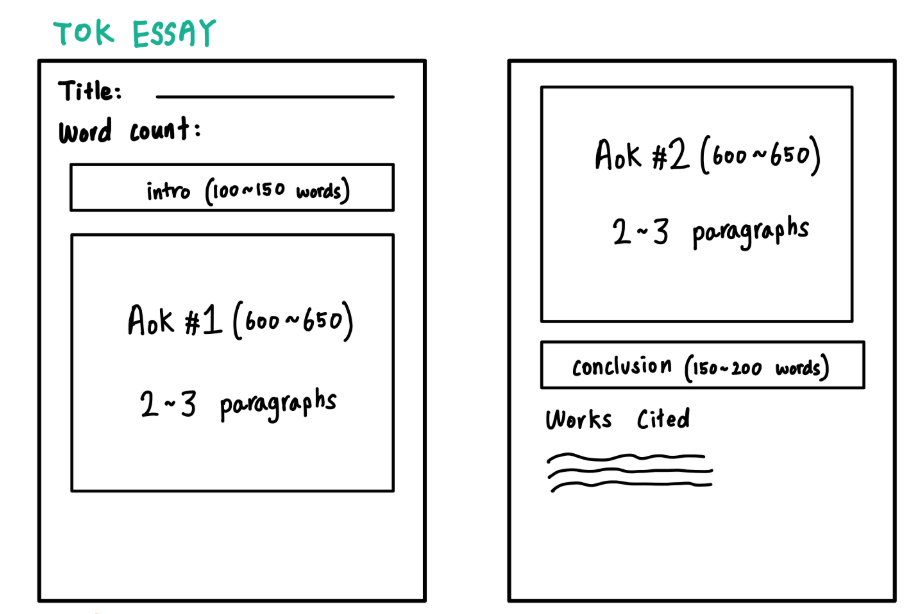
● Note that there are other ways of doing it, and some essay titles don’t specify a limit of two areas of knowledge, so make sure you consult with your teacher extensively
● Make the most of the three interactions to create an effective essay
INTRODUCTION (100~150 words)
1. A ‘hook’ to grab the attention of your readers – this could be an engaging, interesting, intriguing opening, like a quote or a key idea or theory.
2. Explain the key words and ideas of the title, and how you will interpret them.
3. Outline the scope of your essay – ie ,the AOKs you will focus on. Usually, TOK essays ask you to look at 2 different areas of knowledge. The introduction of your TOK essay is massively important! If tricky terms in the title are not defined, or the scope of the essay is not adequately explained, your essay will always struggle to make sense.
—–
Step 1) Identify and explore key phrases or terms in the title.
—There’s no one correct way to approach the intro, but let me tell you the most straightforward method if you’re stuck: try exploring what each keyword or key phrase is and what it isn’t as it relates to what you want to argue. Replicability generally refers to the ability to reproduce an outcome, which differs from the act of replication. While its significance varies across Areas of Knowledge, the term centers on whether achieving the same result is consistently ‘possible,’ not whether it has been replicated. The title asks whether this ability is necessary when producing knowledge, implying some creation of new knowledge. By doing this, I have set the boundaries of each keyword.
—You can check dictionary definitions, but don’t simply list them, because declaring a narrow definition can limit your essay.
—Show examiners that you understood the prompt correctly. You will continue to explore keywords throughout the essay, so you don’t need to define everything in the intro.
—Some titles may ask you to consider specific TOK terms, like ‘methods’ and ‘scope.’ In that case, check related TOK-specific resources and think what they mean.
Step 2) You can also enrich the intro by addressing why answering this question is important in the real world.
—What’s the real-life relevance of this title in our world? Why do we actually have to answer this question? The global replicability crisis, especially in the sciences, forces us to review whether replicability is really a prerequisite for producing reliable knowledge, as we decide on what to trust, and what to discard.
Step 3) Finally, introduce your Areas of Knowledge (AoKs), along with a note on how you are going to answer the title.
—It can be a thesis if you have one overall argument, or you can simply mention how you will approach this essay in each AoK. e.g., Through Natural Sciences and Human Sciences, I explore…/In Natural Sciences, it is… while in Human Sciences..
DISCUSSION 1 (argument) (600~650 words total) AOK 1
● Outline your first claim or argument in your opening sentence. The context for this should be an area of knowledge, which you should clearly identify.
● Your argument should be based VERY CLOSELY on the title – for example, supporting an assertion or quote it includes, and considering why it is valid.
● Discuss this argument in general terms first, without specific examples.
● If you can, mention the ideas of a key thinker.
● Support what you are saying by referring to one or two real-life situations. These can be from your own experiences, or things you have read about.
______
—Here’s one way to answer the title, with an example. After that, I present opposing and different perspectives that give us other ways to answer it.
#1 First Body Paragraph (1st main argument)
Step 1) State your main argument
—Preferably, make an argument about a specific area of study within your AoK (if your AoK is natural sciences, maybe it’s physics.. or chemistry). This ensures that you don’t just talk about the Natural Sciences as a whole, for example.
—One argument per paragraph. In the natural sciences, particularly in classical physics, replicability is necessary for the production of any new law of nature. This is because, under the same conditions, such laws must yield the same outcome universally and consistently…
Step 2) Find a specific example and explain how it supports your argument.
—The example should be real and relevant to your argument (i.e. no hypothetical thought experiments or a list of complicated philosophy concepts). I would need to choose a specific physics law to talk about here.
—Always connect back to your title. “This shows that without replicability, … production of a new law of physics can face severe restrictions…”
Step 3) When possible, consider the implications of your argument.
—Once you’ve explained your example, take a step further: evaluate your argument, connect your point back to your AoK, your title, and maybe even explore what it reveals about knowledge more broadly. This is where you can go beyond ‘explanations’ and show real depth.
#2 Second Body Paragraph (opposing/different perspective)
—Same structure as Paragraph #1 (Steps 1 to 3), but with either an opposing perspective or a different perspective. Although replicability is often considered a must-have in classical physics, some valuable knowledge in physics have been produced through singular, unrepeatable events…
—You can find evidence that directly challenges your previous argument (opposing perspective), or find an example in a different area of study that offers a different kind of argument (different perspective).
#3 (optional) Third Body Paragraph (opposing/different perspective)
—If you decide to write ~200 words for the first two paragraphs, you may consider adding a third opposing/different perspective in the same discipline or a different one (maybe chemistry or biology!) In biology, replicability works in a slightly different way, as it deals with complex biological systems that have thousands of unpredictable variables…
—In fact, I think it’s a good idea to have one to show that you really considered different perspectives. If you aren’t careful, the first and second paragraph can sound like “here’s my argument” and… “here’s why my argument is terrible.” This is not recommended.
______
DISCUSSION 2 (counter-argument) (600~650 words total) AOK 2
● Outline an alternative point of view, or counterargument, to your argument.
● This may involve considering the limitations of the assertion in the title, or disagreeing with it.
● Offer an analysis and justification in a similar way to your argument, again including real-life situations, and, if you can, the idea of a key thinker.
____
—EXACTLY same structure as AoK 1 (1st, 2nd, and optional 3rd paragraph) with your second AoK, different disciplines, and different approaches to the title. Example argument: In the human sciences, achieving replicability is often more difficult. Consider cultural anthropology, where fieldwork conducted in specific communities cannot be exactly replicated, yet the knowledge it produces still holds great value.
—Add one or two more paragraphs…
____
INTERLINKING AOKS
● Link the second AOK to the first AOK, by comparing and contrasting how they both relate to the question.
DISCUSSION 2 (argument)
● State your second claim or argument. This will probably be similar to your first argument, but now in the context of your second AOK.
● Discuss this claim in general terms first, without specific examples. Again, the idea of a key thinker would be good to include here.
● Support what you are saying by referring to one or two real-life situations. These can be from your own experiences or things you have read about.
DISCUSSION 2 (counter-argument)
● Outline an alternative point of view, or counterargument, to your argument.
● This may involve considering the limitations of the assertion in the title, or disagreeing with it.
● Offer an analysis and justification similarly to your argument, again including real-life situations, and, if you can, the idea of a key thinker.
CONCLUSION (150-200 words)
● Restate the key points of your essay, and answer the question directly.
● Don’t sit on the fence – have a position on what you’re exploring.
● Try to tell your reader something they didn’t already know.
● A conclusion can often be improved by drawing on a quote from a relevant thinker.
___
Now that I’ve presented all my arguments, here’s my overall claim again, and what I learned about knowledge itself.
Step 1) Briefly synthesize your arguments into one final observation. What’s your overall argument? Don’t simply rewrite your thesis. While replicability is a defining feature of production of knowledge in the natural sciences, especially in disciplines like classical physics, its role in the human sciences is more complex. Whether replicability is absolutely necessary may depend on both the context in which knowledge is produced, as well as its practical applications.
Step 2) Discuss the implications of the arguments you made.
—What do these arguments say about AoKs or knowledge in general? How and why are they important in the real-world (for us, for people, for the world)? Sometimes, there is a trade-off between ensuring replicability and recognizing the practical usefulness of knowledge produced, making us question how much flexibility we can or should tolerate in real-world situations...
___
BIBLIOGRAPHY
Your bibliography should include only the books, magazines, webpages, etc. that you have used directly. There’s no mandatory format, but you should be consistent and clear, and arrange the publications in alphabetical order and/or in order of source type.
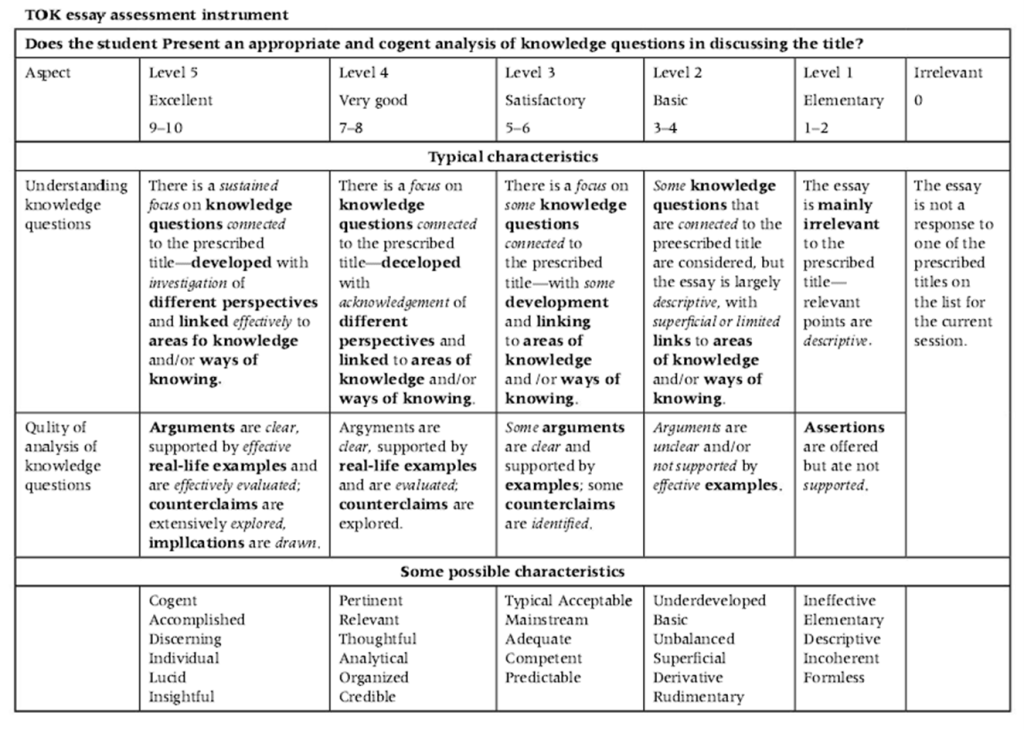
Characteristics of effective and ineffective essays. Highlight in different colours which of these aspects are effective, and which are counterproductive.
1. Shows an awareness of his or her own perspective as a knower in relation to other perspectives 2. Lots of generalizations
3. RLSs chosen because of suitability rather than interest
4. Arguments in the essay are fully justified
5. Clear and coherent arguments
6. Examples are fresh, original, and specific
7. Not enough personal thoughts and opinions
8. Misunderstandings about the nature of the AOKs – for example, confusing ‘history’ with ‘the past’, or treating the arts purely in terms of artistic techniques
IB ToK Essay Titles and Topics: November 2025
Here are links to ideas and suggestions relating to the the six November 2025 IB ToK Essay topics:
- Topic 1. For historians and artists, do conventions limit or expand their ability to produce knowledge? Discuss with reference to history and the arts.
- Topic 2. What is the relationship between knowing and understanding? Discuss with reference to two areas of knowledge.
- Topic 3. Should knowledge in an area of knowledge be pursued for its own sake rather than its potential application? Discuss with reference to mathematics and one other area of knowledge.
- Topic 4. To what extent do you agree that however the methods of an area of knowledge change, the scope remains the same. Answer with reference to two areas of knowledge.
- Topic 5. In the pursuit of knowledge, is it possible or even desirable to set aside temporarily what we already know? Discuss with reference to the natural sciences and one other area of knowledge
- Topic 6. Is empathy an attribute that is equally important for a historian and a human scientist? Discuss with reference to history and the human sciences.
I briefly mention some points to consider for each topic below; however, the personalised service I offer is tailored to each student.
You should be very wary of simply repeating phrases and words from ToK websites.
In particular, basing your essays on downloaded templates carries considerable risks. First, you don’t know with whom you are dealing.
Secondly, your essay will share the same structure as many others and will likely be considered as plagiarised. As an experienced philosophy and ToK examiner I know how easy it is to identify essays with a common source.
At any time, you can access free podcasts, videos, and articles, relevant to your IB ToK essay or presentation, from the site’s social media pages.
The posts also provide links to discussions of WoKs, AoKs and real-life examples; so it’s worth following or liking them:
 gozdetorunacademy